Why Does My Dental Implant Feel Loose? Causes & What to Do
If your dental implant feels loose, it's usually the crown or the abutment screw, not the implant itself, and it's often fixable in one visit. But a wobble in the implant post can mean infection or failed bone integration. Stop chewing on that side and call us within 24 to 48 hours. Early treatment often saves the implant.
If your dental implant feels loose, it's usually the crown or the abutment screw, not the implant itself, and it's often fixable in one visit. But a wobble in the implant post can mean infection or failed bone integration. Stop chewing on that side and call us within 24 to 48 hours. Early treatment often saves the implant.
We hear this call a lot. A patient who had an implant placed two or three years ago suddenly feels a tiny shift while eating dinner. Panic sets in. The good news: at La Mirada One Dental, the vast majority of these cases turn out to be small mechanical problems, not lost implants.
Let's walk through what's actually happening in your mouth.
Is it the implant itself, the crown, or the screw that's loose?
According to the American Dental Association, a dental implant has three parts stacked together. The titanium post sits inside your jawbone. The abutment is the small connector that screws into the post. The crown is the tooth-shaped piece you see and chew with.
Each piece can loosen independently. That matters a lot.
Here's a simple at-home check. Gently touch the tooth with a clean fingertip. If only the top portion wiggles, the crown or the abutment screw is likely the culprit. If the entire structure rocks side to side, including what feels like the root, the problem may be deeper in the bone.
Do not keep wiggling it to test. We mean that. Repeated movement can strip threads or push bacteria deeper around the implant.
What causes a dental implant crown to come loose?
In our office, patients often ask if they did something wrong. Usually not. Crowns come loose for predictable reasons.
Cement washout. Cement-retained crowns rely on a thin layer of dental cement. Over years, saliva and chewing can break that bond.
Abutment screw loosening. Research published in the Journal of Prosthetic Dentistry consistently ranks this as one of the most common mechanical complications of single-tooth implants. Tens of thousands of bite cycles per year add up.
Bruxism. If you grind or clench at night, that force transfers straight into the screw. The screw eventually backs out.
An uneven bite. If the implant crown sits even slightly high, it absorbs more force than its neighbors. Small bite imbalance, big mechanical consequence.
None of these mean your implant has failed. They mean a torque wrench, a new screw, and twenty minutes in our chair.
When does a wobble mean true implant failure?
Sometimes the news is more serious. True implant failure usually involves either infection or a breakdown of osseointegration, which the National Institute of Dental and Craniofacial Research describes as the biological fusion of bone to the titanium surface.
The two main culprits:
Peri-implantitis. This is gum and bone infection around the implant. The American Academy of Periodontology estimates it affects roughly 10 to 20 percent of implants over time. It's quiet at first, then aggressive.
Failed osseointegration. The bone never fully fused, or it lost grip over time.
Warning signs we look for during diagnosis:
Pain when you bite down
Gum recession around the implant
Pus or persistent bad taste
Bleeding when brushing that area
Visible threads of the implant post
Smoking and uncontrolled diabetes raise the risk significantly, a connection well documented by the NIDCR and the American Association of Oral and Maxillofacial Surgeons. Daily flossing around implants matters more than people realize.
What should I do right now if my implant feels loose?
Take a breath. Then take these steps.
Stop chewing on that side. Soft foods on the opposite side until you're seen.
Don't wiggle it. You can damage the internal threads of the abutment, which turns a simple fix into a complex one.
Rinse with warm salt water two or three times a day if the gum feels tender.
Call us within 24 to 48 hours. Time matters. A loose screw caught early is a quick visit. A loose screw ignored for a month can fracture inside the implant body.
We offer a free emergency dental exam for situations exactly like this. Saturday hours mean you don't have to wait until Monday wondering. Patients drive in from Cerritos, Norwalk, Whittier, and the Biola University area along Imperial Highway and the I-5 corridor.
A real example. A grandmother in La Mirada, mid-sixties, came in on a Saturday morning after feeling her front implant crown shift during breakfast. She'd had the implant placed elsewhere four years earlier. CBCT scan showed the post was solid in the bone. The abutment screw had backed out about a quarter turn. We retorqued the screw, resealed the access hole, checked her bite, and she was home by lunch. Total chair time: twenty-five minutes.
How do we fix a loose implant at La Mirada One Dental?
Every case starts with a real diagnosis, not a guess.
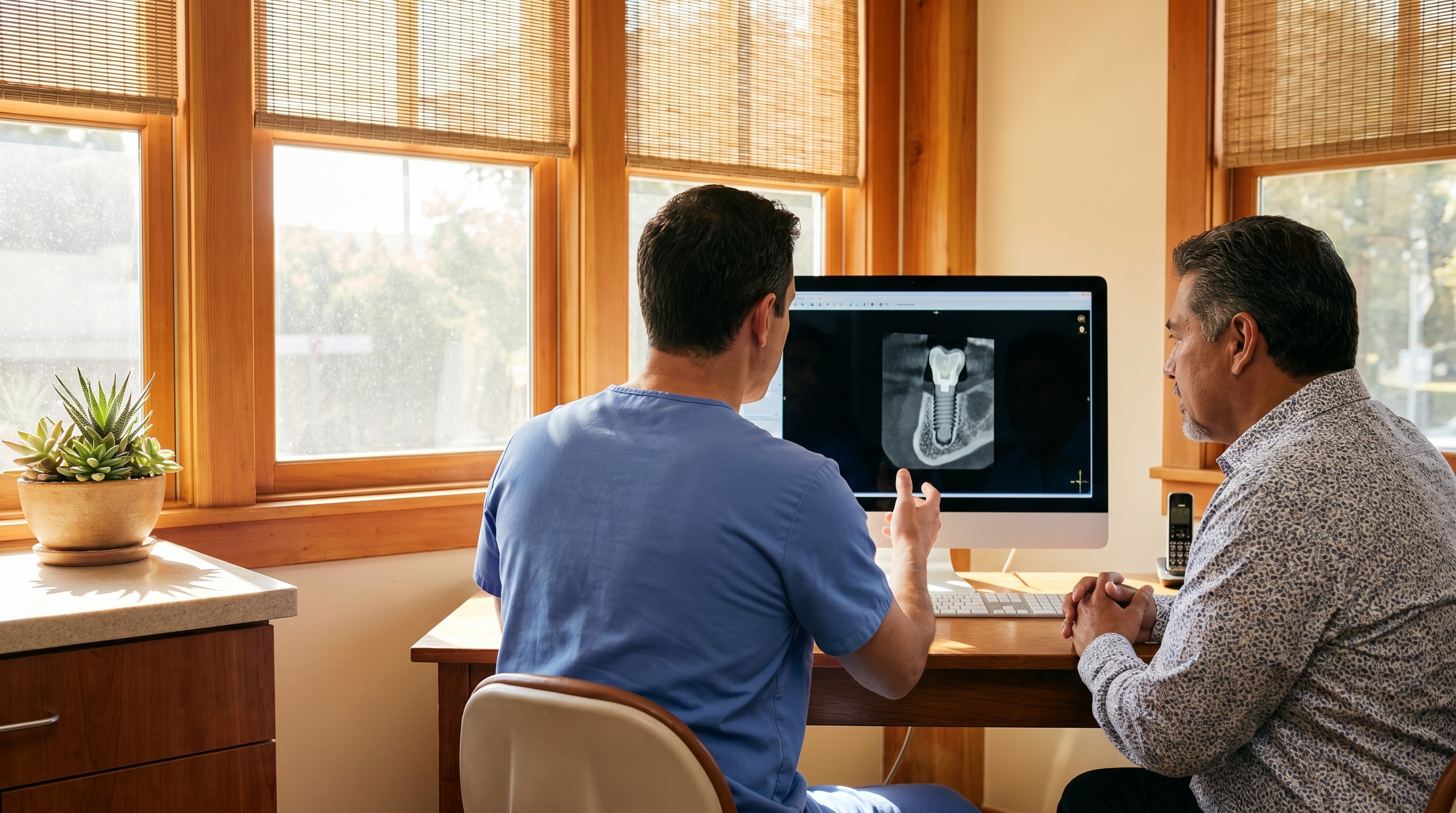
We use CBCT 3D imaging to look at bone levels around the implant. That tells us in minutes whether we're dealing with a mechanical problem or a biological one. From there:
Loose abutment screw. We access the screw, clean the threads, and retorque it to the manufacturer's exact specification. Then we seal the access hole.
Loose crown over a stable implant. We re-cement it, or fabricate a new crown if the original is worn or damaged.
True implant failure. We carefully remove the implant, graft bone if needed to preserve the site, and plan a replacement once healing is complete. This is not a failure of you. It's biology.
Prevention is the part most patients skip. If you grind, a custom nightguard is the single best investment you can make in your implants. Six-month implant checks let us catch a loose screw before it becomes a fractured one. That's the whole trick.
Frequently Asked Questions
Can a loose dental implant tighten on its own?
No. A loose abutment screw or crown will not retighten with chewing or time. Continued use almost always makes it worse, because every bite cycle works the screw further out or wears down the cement seal. The fix is quick when caught early.
How long do I have before a loose implant becomes an emergency?
If there's no pain, swelling, or bleeding, you have a window of a few days to be seen, ideally within 24 to 48 hours. If you have pain on biting, pus, or visible movement of the implant post itself, treat it as urgent and call right away.
Will I lose the bone if my implant fails?
Some bone loss is possible, especially with peri-implantitis. The earlier we intervene, the more bone we preserve. If removal is necessary, we often place a bone graft at the same time to maintain the site for a future implant.
Does insurance cover fixing a loose implant?
It depends on your plan and whether the original implant was placed by us. Many PPOs cover repair of the crown or screw. Implant replacement coverage varies widely. We'll review your benefits before any treatment and discuss the in-house membership plan or CareCredit if insurance falls short.
Can I still eat with a loose implant crown?
You can eat, but only on the opposite side, and only soft foods. Chewing on a loose implant risks fracturing the abutment screw inside the implant body, which is a much harder repair than simply retightening a screw. Be gentle until you're seen.
If something feels off with your implant, don't wait it out. Call La Mirada One Dental at (562) 777-1234 and we'll get you in, often the same week. We'll figure out exactly what's loose, why, and how to fix it.